


Most guides to starting an SEO business spend their first thousand words on market-size projections. They are the least useful part, because the size of the global SEO market has almost no bearing on whether you can find your third client.
What decides that is narrower: whether you can do the work, whether anyone trusts you to do it yet, and whether you have priced it so the business survives the months where nothing is ranking. This covers those, in the order you actually hit them — whether you are starting an SEO business on your own, building an SEO agency with a team, or somewhere between the two.

Decide what you are actually selling
"SEO agency", "SEO company" and "freelance SEO consultant" get used interchangeably, and they are three different businesses with different economics.
- Freelance consultant. You sell your own hours. Margins are high, overheads are near zero, and the ceiling is the number of hours you have. Easiest to start, hardest to grow beyond yourself.
- Productised service. You sell a defined deliverable at a fixed price — a technical audit, a migration plan, a monthly link package. Easier to sell than open-ended retainers because the buyer knows exactly what arrives, and far easier to delegate, because the process is written down.
- Full-service SEO agency. You sell outcomes across strategy, content, technical work and off-page. Highest ceiling, and the only one of the three with real fixed costs, real hiring, and real cashflow risk. This is what most people picture when they talk about starting an SEO company, and it is the hardest of the three to start cold.
Most people who say they want to start an SEO agency want a productised service to begin with. It is the version that gets you paid soonest, and it teaches you which parts of the work you can actually systematise — which is the thing that decides whether an agency is possible later.
The services underneath
Whichever shape you pick, the delivery work is the same set of disciplines:
- Keyword research — finding the terms worth targeting and the intent behind them.
- On-page — titles, meta descriptions, structure, internal linking.
- Technical SEO — crawlability, indexation, site speed, migrations.
- Off-page — outreach and link building, digital PR, brand mentions.
- Content — producing the pages that the research says should exist.
- Analytics — Search Console and GA4, and the reporting that turns them into something a client understands.
You do not need to be strong at all six. You need to be genuinely good at one, competent at the rest, and honest about the difference.
Build the skill before you sell it
Use your own site as the proving ground
The fastest way to learn SEO is to rank something you own, because it is the only project where you see every decision through to its consequence without a client's patience running out. Break it, fix it, watch what moves in Search Console.
It also solves the portfolio problem. A site you took from nothing to ranking is a case study you can show without asking anyone's permission.
Research the market you are entering, not the industry
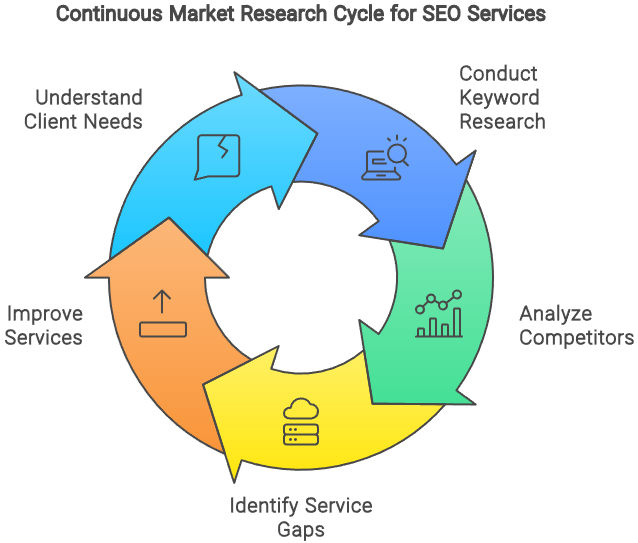
Market research in this context does not mean reading industry reports. It means:
- Running keyword research on the services you intend to sell, in the places you intend to sell them, to see what demand actually exists.
- Looking at who already ranks for those terms and what they charge.
- Finding the gap. Usually it is a vertical nobody serves properly, or a service everyone sells badly.
That last one matters more than it sounds. "SEO for dentists in my city" is a business. "SEO" is not.
Winning the first clients
This is the part most guides skip, and it is the part that kills most new SEO businesses. You are selling something invisible, slow and easy to fake, to buyers who have usually been burned before.
Start where you already have trust. Former employers, people who have seen you work, local businesses where someone can vouch for you. The first three clients almost never come from a cold channel, and expecting them to is why people give up in month four.
Lead with an audit, not a pitch. A short, specific audit of a prospect's site — three real problems, what they cost, what fixing them involves — outperforms any deck. It demonstrates competence instead of claiming it, and it is the same work you would do in week one anyway.
Be concrete about timelines. SEO takes months. Say so before you are hired, in writing. Clients who are told this up front tolerate month three; clients who were sold "results fast" cancel in month three and tell people you did not deliver.
Educate, then quote. Many buyers do not know what they are purchasing, so they compare on price alone. Show them what the work involves and what it changes and the conversation stops being about the cheapest quote. Case studies do this better than explanation.
Pricing the work
Pricing badly is the most common self-inflicted wound in this business. Four models, and the tradeoffs are real:
Hourly. Simple and transparent. It also punishes you for getting faster, and caps your income at your available hours. Reasonable for advisory work, poor for delivery.
Monthly retainer. The standard for ongoing SEO, and the right fit because the work is ongoing. The risk is scope creep: without a defined deliverable, a retainer quietly becomes unlimited access. Write down what the month includes.
Project or productised. A fixed price for a fixed deliverable — an audit, a migration, a content build. Best cashflow, easiest to sell to a first-time buyer, and the model that scales because someone else can eventually run the process.
Performance-based. Payment tied to rankings or traffic. Clients love the idea. Be careful: you are taking on risk for factors you do not control, including whether the client ships your recommendations. If you offer it at all, tie it to something you actually govern.
Whatever you choose, be transparent about what it covers. Vague pricing does not protect your margin; it just delays the argument.

What breaks when you grow
Everything above works for one person with a handful of clients. The failure modes change as soon as you add volume or people.
Delivery stops fitting in your head. The informal system that worked across three clients falls apart across twelve. Whatever you do repeatedly needs writing down — not as bureaucracy, but because a process you cannot describe is a process you cannot hand to anyone.
Quality control becomes the bottleneck, not production. It is easy to increase output. It is hard to keep it good. Building the checks before you need them is far cheaper than retrofitting them after a client notices.
Everything gets harder in a second language or market. Running email outreach across nine regions taught me this the expensive way: templates that perform in one market land badly in another, sending infrastructure behaves differently, and the deliverability problem compounds with every domain you add. Test per market rather than assuming what worked travels.
Measure what you change. A/B testing outreach copy is the difference between knowing your reply rate improved and believing it did. The same applies to everything else you scale: if you cannot tell which change caused the result, you are not systematising, you are just doing more.

Hiring and outsourcing
SEO spans more disciplines than any one person covers well, so at some point you buy in the gaps.
Outsource the specialism you are weakest at first. If link building is your weak point, an outreach specialist beats you spending six months becoming mediocre at it.
Freelancers manage load; hires build capability. A freelancer absorbs a spike. Someone on the team accumulates context about your clients and your process. Use each for what it is, and do not hire to solve a problem that is really a burnout problem.
Marketplace or network. Upwork and Fiverr give you range and reviews to sort by. Your own network gives you people who are already vouched for. Both work; the network route has a much better hit rate.
Communication is the actual skill. The thing that decides whether outsourcing works is not the freelancer's ability. It is whether your brief is specific enough that good work is the likely outcome. Vague briefs produce vague deliverables at every price point.

Running it once it exists
Past a certain size your job stops being SEO and becomes managing people doing SEO. This is the point where a freelance practice becomes an agency in everything but name, and the transition catches people out, because the two skill sets barely overlap.
Use a real project tool. Asana, Trello, Jira, ClickUp — the specific choice matters far less than having one place where deadlines and ownership live. Client work tracked in your inbox does not survive a holiday.
Report on outcomes, not activity. A client does not want a list of what you did. They want to know whether it worked, and what happens next. Reporting that answers those two questions is most of retention.
Keep one project of your own. The moment all your SEO is on client sites, you stop experimenting, because nobody experiments with someone else's revenue. Your own site is where you keep learning.
The honest part
An SEO business is not passive income and it is not fast. Results take months, buyers are sceptical for good reasons, and the discipline changes underneath you often enough that last year's playbook needs revisiting.
What makes it work is unglamorous: pick a narrow thing you are genuinely good at, price it so you can survive the slow months, write down what you do repeatedly, and be straight with clients about timelines before they are clients.
If you want to see what this looks like in practice rather than in theory, my career history covers the route from junior outreach specialist to managing the work, and the case studies cover the results.