


Every conversation about email marketing starts with the message — the subject line, the offer, the call to action. Almost none of it matters if the email never arrives. Deliverability is decided before you write a word, by the quality of the list you are sending to and the reputation of the domain you are sending from.
Why list quality decides deliverability
Mailbox providers do not judge each email on its own. They judge the sender. Every send contributes to a reputation score attached to your domain and your sending IP, and that score decides whether the next campaign lands in the inbox, the promotions tab, or the spam folder.
A dirty list damages that score in three ways at once:
- Hard bounces. Addresses that no longer exist. Most providers start treating you as careless somewhere around a 2% hard bounce rate, and some ESPs will suspend an account well before that.
- Spam traps. Addresses that exist only to catch senders who do not clean their lists. A recycled trap is a real address that was abandoned and repurposed — which is exactly what an old, unmaintained list is full of. A pristine trap was never a real person at all, and usually means the address was scraped or bought.
- Silence. Sustained low engagement is itself a negative signal. A list where nobody opens anything looks, to a filter, like a list that did not consent.
This is why buying a list never works out. You are not just paying for addresses of dubious quality — you are paying to inherit somebody else's reputation problem.
Get authentication right before anything else
No amount of list cleaning saves an unauthenticated domain. Three records do the work, and all three should exist before you send at any volume:
- SPF declares which servers are allowed to send on your domain's behalf.
- DKIM signs each message so the recipient can verify it was not altered in transit.
- DMARC tells providers what to do when SPF or DKIM fails, and — more usefully — gives you reports on who is sending as you.
Gmail and Yahoo both tightened their requirements for bulk senders, and authentication moved from good practice to a precondition. If you are sending from a new domain, warm it gradually: a few hundred messages a day to your most engaged contacts, building over several weeks. A cold domain that suddenly sends ten thousand emails looks exactly like a compromised one.
How to clean an email list
1. Validate regularly
Validation services such as ZeroBounce check the syntax, domain and mailbox of each address and filter out invalid, risky or temporary ones. Run this before any significant send, not once a year.
Catch-all addresses deserve their own rule. A catch-all domain accepts mail to any address, so validation cannot confirm whether a specific mailbox exists. They are riskier by definition, but a catch-all at a real, high-quality company is often still a contact worth keeping. Treat them as their own segment and watch how they behave rather than deleting or trusting them wholesale.
2. Audit manually
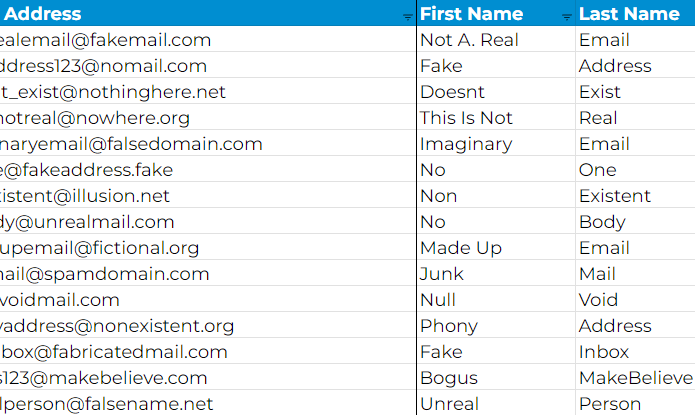
Tedious, and still worth it. Scan for the errors validation cannot infer: [email protected] is syntactically perfect and will bounce every time. Role addresses — info@, sales@, admin@ — are a separate judgement call: they are legitimate, but they convert poorly and complain more often than a named contact.
3. Monitor engagement, and act on it
Engagement data tells you who is worth sending to. The people opening and clicking are your list; the rest are ballast.
Adopt a sunset policy: after a defined period of no engagement, stop sending. Before you do, send one email inviting them to stay — and make the unsubscribe easy rather than hidden. It feels counterintuitive to encourage people off your list, but an unsubscribe is a clean exit while a spam complaint is a mark against your domain. Make sure the List-Unsubscribe header is set so the mailbox provider's own one-click option works.
A smaller, engaged list outperforms a larger, indifferent one on every metric that matters, and it costs less to send to.
4. Treat it as maintenance, not a project
Lists decay continuously — people change jobs, abandon addresses, lose interest. Validate on a schedule, re-segment on a schedule, and expect to lose a percentage of the list every year. That attrition is normal and healthy.
Who you send to matters as much as how clean the list is
A clean list still fails if the targeting is wrong. This is where segmentation stops being jargon and starts being the thing that decides your reply rate.
Segment by something that changes the message. Industry, company size, role, lifecycle stage, past behaviour — any attribute that would make you write a genuinely different email. Splitting a list into groups you then send the identical message to is bookkeeping, not segmentation.
For cold outreach, research is the segmentation. At any serious volume you cannot research every prospect individually, and pretending otherwise produces the worst of both worlds: templated mail wearing a thin personalisation layer. What works is researching the segment properly — the shared problem, the shared vocabulary, the shared reason this is relevant now — and reserving individual research for the small number of contacts where the payoff justifies it.
Fewer, better-aimed emails beat volume. Not for moral reasons, but arithmetic ones: every poorly-targeted send costs you reputation that the next well-targeted one has to pay for. Volume without relevance actively spends down the asset that makes email work at all.
The metrics worth trusting
Be careful which numbers you optimise against.
Open rate is no longer reliable. Apple's Mail Privacy Protection pre-loads tracking pixels regardless of whether the recipient opened anything, which inflates opens for a large and unknowable share of your audience. Treat open rate as a loose directional signal and nothing more.
Delivery rate, click rate, reply rate and complaint rate are the real ones. Delivery tells you whether the list and the authentication are sound. Clicks and replies tell you whether the targeting and the message are. Complaint rate — anything approaching 0.3% is trouble — tells you when to stop.
Watch them per segment rather than in aggregate. A healthy overall number routinely hides one segment quietly damaging your sender reputation for everyone else.
The bottom line
Deliverability is not a setting you configure once. It is the cumulative result of who you send to, how often you clean the list, whether your domain is properly authenticated, and whether the people receiving your email wanted it. Get those right and the message gets a chance. Get them wrong and the best copy you have ever written goes to a folder nobody opens.
For how this works at scale — multiple markets, multiple languages, and a real team behind it — see outreach and link building.